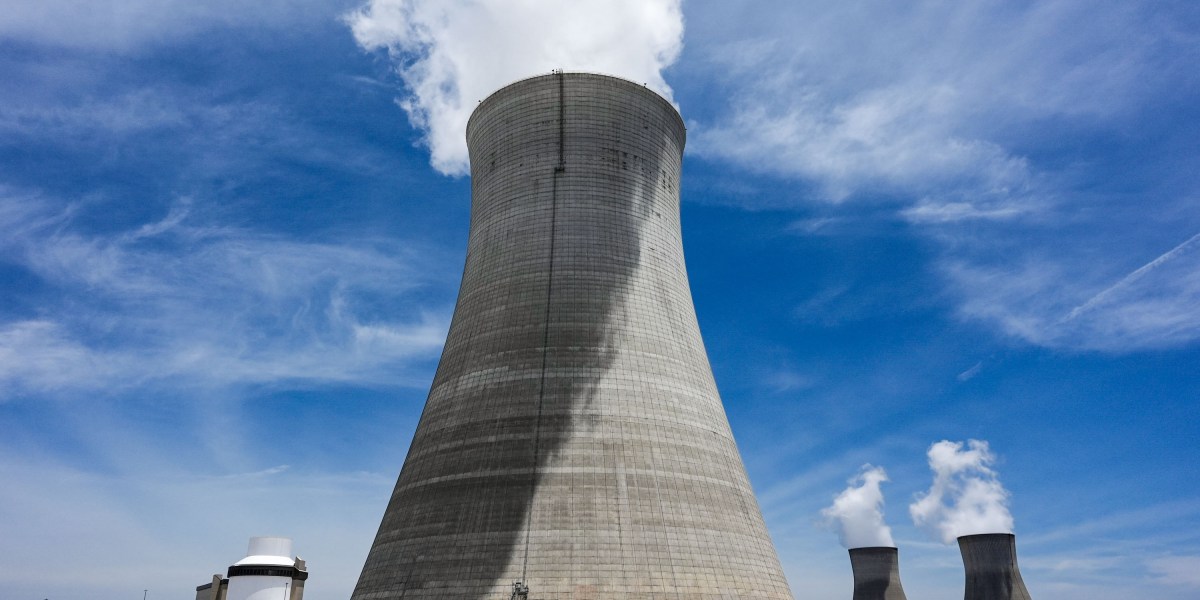
A recent NPR investigation found that the Trump administration had secretly rewritten nuclear rules, stripping environmental protections and loosening safety and security measures. The government shared the new rules with companies that are part of a program building experimental nuclear reactors, but not with the public.
I’m reminded of a talk during our EmTech MIT event in November, where Koroush Shirvan, an MIT professor of nuclear engineering, spoke on this issue. “I’ve seen some disturbing trends in recent times, where words like ‘rubber-stamping nuclear projects’ are being said,” Shirvan said during that event.
During the talk, Shirvan shared statistics showing that nuclear power has a very low rate of injury and death. But that’s not inherent to the technology, and there’s a reason injuries and deaths have been low for nuclear power, he added: “It’s because of stringent regulatory oversight.”
Are next-generation reactors going to be financially competitive?
Building a nuclear power plant is not cheap. Let’s consider the up-front investment needed to build a power plant.
Plant Vogtle in Georgia hosts the most recent additions to the US nuclear fleet—Units 3 and 4 came online in 2023 and 2024. Together, they had a capital cost of $15,000 per kilowatt, adjusted for inflation, according to a recent report from the US Department of Energy. (This wonky unit I’m using divides the total cost to build the reactors by their expected power output, so we can compare reactors of different sizes.)
That number’s quite high, partly because those were the first of their kind built in the US, and because there were some inefficiencies in the planning. It’s worth noting that China builds reactors for much less, somewhere between $2,000/kW and $3,000/kW, depending on the estimate.
The up-front capital cost for first-of-a-kind advanced nuclear plants will likely run between $6,000 and $10,000 per kilowatt, according to that DOE report. That could come down by up to 40% after the technologies are scaled up and mass-produced.
So new reactors will (hopefully) be cheaper than the ultra-over-budget and behind-schedule Vogtle project, but they aren’t necessarily significantly cheaper than efficiently built conventional plants, if you normalize by their size.
#questions #nextgeneration #nuclear #power #answered
